

Table of Contents
About Portable Eddy Current Testing Equipment
When it comes to inspecting critical components, finding a defect early can make a significant difference to the safety, performance and service life of the component. This is where Eddy Current Testing (ECT) plays an important role. It offers a fast non-destructive way to identify surface and near surface defects in electrically conductive materials without damaging the component or interrupting its usability.
As inspection requirements increasingly move beyond controlled laboratory environments to the manufacturing factory environments, portable eddy current testing equipment has become a practical choice for many industries. Instead of bringing large or complex structure components to the inspection stations or laboratories, inspection can be carried out at the site where the components are manufactured. Compact, easy to operate, and capable of delivering results instantaneously at the inspection site, these systems make portable eddy current testing equipment more flexible for manufacturing and field application.
Modern portable systems also combine advanced signal processing with user-friendly interfaces, helping inspectors identify and evaluate discontinuities efficiently. From crack detection in aerospace and automotive components to routine inspections in power generation and industrial maintenance, portable technology has expanded the possibilities of reliable onsite NDT.
Looking for reliable Portable Eddy Current Testing Equipment for your inspection requirements? Contact our team to discuss the right solution for your application.
What is Portable Eddy Current Flaw Detector?
A portable eddy current flaw detector is a compact NDT instrument used to identify surface and near surface defects in electrically conductive materials. It works on the principle of passing on alternating current through a probe, which creates an electromagnetic field. When the probe moves over the test component, any change caused by a crack, discontinuity, corrosion or material variation affects the eddy current flow. Our highly sensitive instrument detects these changes and displays them as signals that the inspector or operator can analyse.
The biggest advantage of a portable eddy current tester is its flexibility. Instead of moving a large or difficult to handle component to the inspecting station, the inspector can simply take the portable eddy current tester to the component.
How does Portable Eddy Current Testing work?
Portable eddy current testing uses a probe to create an electromagnetic field on the surface of a conductive test material. The handheld probe sends an alternating magnetic field into the conductive material/component. If the probe passes over the crack, corrosion, or material change, the flow of the eddy current gets disrupted. The detector picks those changes and converts them into signals, helping the operators to spot and assess possible flaws (defects) without causing any damage to the component.
Why choose Portable Eddy Current Equipment?
A good portable eddy current testing machine should offer more than just mobility or portability. It should make inspection easier, faster, and more dependable in actual working conditions. Let’s take a glance at its features in brief.
- Compact & Lightweight Design – A portable instrument is easy to carry and operate, especially when inspections involve large components or difficult to access areas.
- High sensitivity – The ability to detect small surface and near surface discontinuities is essential, particularly for applications involving critical automobile and aircraft components.
- Wide Frequency range – Different material, component grades, and defect depths may require different inspection frequencies. A suitable frequency range gives the operator more flexibility.
- Probe compatibility – Different components & inspection areas require different probes. Compatibility with a range of probes makes the equipment more versatile and suitable for various applications.
- Signal processing capabilities – Features such as filtering, gain adjustment, and phase analysis can help separate relevant defect signals from background noise and make evaluation easier.
- Data storage & reporting – The ability to save inspection results can be valuable for documentation, traceability, and future reference, particularly in quality-critical industries, as well as to meet the requirements of many standards.
- Rugged construction – Since portable equipment is often used in demanding industrial and field environments, a durable design is important for reliable day to day operations and long life to the instrument.
- Simple operation – An intuitive interface allows the inspector/operator to set parameters and carry out inspection efficiently, reducing unnecessary complexity during fieldwork.
Where Portable Detectors are used (Applications)
Portable eddy current flaw detectors are useful wherever inspections need to be carried out quickly, directly at the component, without damaging it and at various sites. These are engineered as per the requirement of the field and maintenance application.
- Aerospace – Used for detecting surface & near surface in aircraft structures, fastener holes, landing gear, and other critical components
- Automotive – Suitable for inspecting gears, shafts, bearing, and other machined components for cracks and material discontinuities.
- Power Generation – Used during maintenance and shutdown inspections of conductive components, helping & identifying defects before they lead to failures
- Oil & Gas – Useful for inspecting pipelines, fittings, heat exchanger components, and other equipment for cracks and material degradation.
- Manufacturing – Helps with quality checks during production, particularly where fast and repeatable inspection is required
- Maintenance & field inspection – Particularly valuable for large, heavy, or installed components that are difficult to move to a fixed testing system.
Have a field inspection application in mind? Contact us to discuss how Portable Eddy Current Testing equipment can fit into your inspection process.
How to choose the right portable Eddy Current Detector?
Choosing the right portable eddy current detector is largely about matching the instrument to the component you want to inspect and type of discontinuity you are looking for. The following factors can help make the selection.
- Know what you need to inspect – Choose the system based on the type of the defect to be detected, e.g. cracks, corrosion, near surface defects, or material variation.
- Select the right probe – The probe should match the inspection area so as to work well for general surface scanning. Specialised rotating probes can also be used for bolt holes.
- Match material component – Material conductivity, shape, and surface condition can influence the inspection. Ensure the probes are suitable for the component.
- Check frequency option – Different materials and inspections may require different frequencies. A flexible frequency range allows the same instrument to handle varied applications.
- Look for easy signal evaluation – Clear signal display filtering and adjustable gain can make defect indications easier to identify and interpret.
- Consider field use – While inspecting on site factors like battery life, weight, and ruggedness helps increase the efficiency of the operator.
- Consider data recording – For inspections that require traceability, data storage, and reporting features.
The right portable eddy current detector is ultimately the one that offers the right probe, settings, and functionality to your specific inspection requirement, along with easy to use and precise results.
Explore our solutions for Portable Eddy Current Testing
FOERSTER Germany has over seven decades of expertise in eddy current technology. FOERSTER INSTRUMENTS INDIA PVT. LTD (FIIND), we bring world-class inspection systems directly to Indian manufacturers.
The TCM is a FOERSTER’S versatile eddy current testing (ECT) platform that combines low frequency (LF) and high frequency (HF) testing with DEFECTOMETER for precise detection of smallest crack, all in a simple compact system, this eliminates need for multiple instruments.
DEFECTOSCOP TCM : Advanced eddy current testing
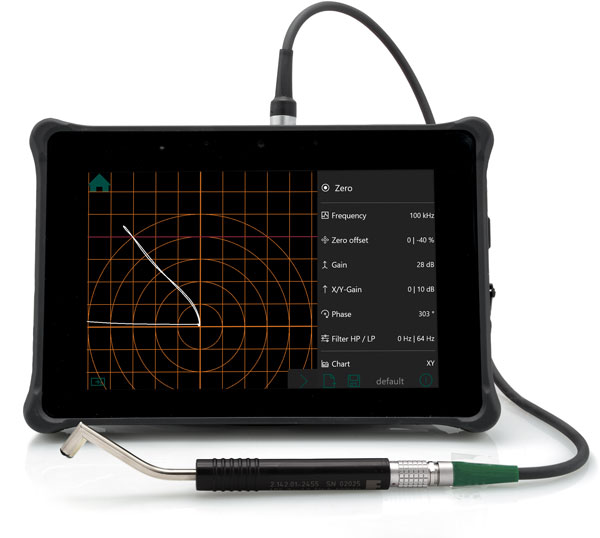
The DEFECTOSCOP converts TCM into a universal eddy current testing system powered by FOERSTER. It combines precision with an intuitive app driven interface.
KEY FEATURES:
- Broad compatibility – Works with high frequency (HF), low frequency (LF) and rotating probes.
- Dual operating modes – Features expert mode for custom parameter setup and operator mode to lock settings and prevent accidental changes.
- Stable Signals – integrated lift off compensation and frequencies minimize interference and surface variations.
- Advance Data Analysis – Generates high resolution c-scan for rotating parts. Freeze mode allows post-test adjustment of gain, phase, and filters without repeating inspection.
- Easy export – saves raw signal data for offline analysis and documentation.
DEFECTOMETER : Mobile Crack and Material Testing
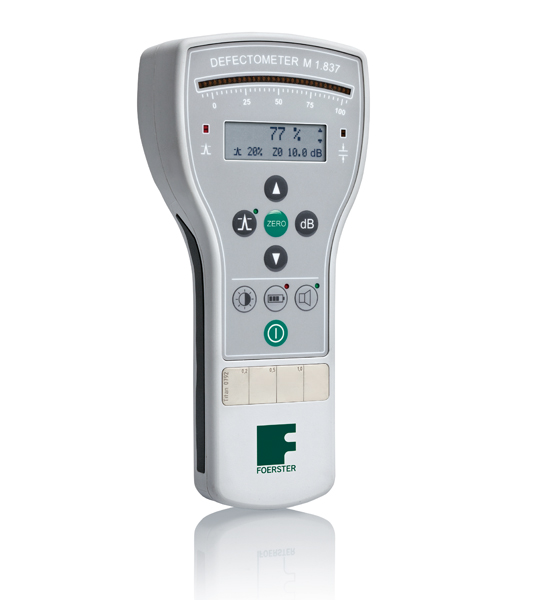
DEFECTOMETER M 1.837 is a compact handheld eddy current testing device engineered for non-destructive inspections across aerospace, automotive, and infrastructure components.
KEY FEATURES
- High precision & Sensitivity – Detects fine surface cracks starting from a defect resolution of 20 µ/m alongside hardness testing and material inspection.
- Flexible application – supports various probe types and includes integrated calibration standards for quick adjustments.
- Reliable & re-producible data – Features automatic lift off zero and tilt compensation plus an alert warning when the probe loses contact.
- Optimized Display & Ergonomics – High readability LED scale display and LCD screen perform in bright daylight or dark settings packed into an ergonomic onehanded device.
- Long Mobile Runtime – Delivers up to 35 hrs of battery life with the backlight enabled for extended field operations.
Conclusion
Portable eddy current technology has made NDT inspection more flexible and efficient in the field environment. Eddy current crack detection of the critical components for routine inspection and maintenance, a well-designed portable system can provide rapid, non-destructive evaluation without requiring components to be transported to a laboratory.
A right portable eddy current testing machine should offer an effective combination of detection sensitivity, suitable frequency ranges, probe compatibility, intuitive operations, data management and field durability. By matching these capabilities with the material, component geometry and inspection objective, industries can achieve more efficient and dependable inspection processes while maintaining the quality and integrity of critical components.
Ready to choose the right Portable Eddy Current Testing Equipment?
Contact our experts today to discuss your application, inspection requirements, and suitable equipment options.