


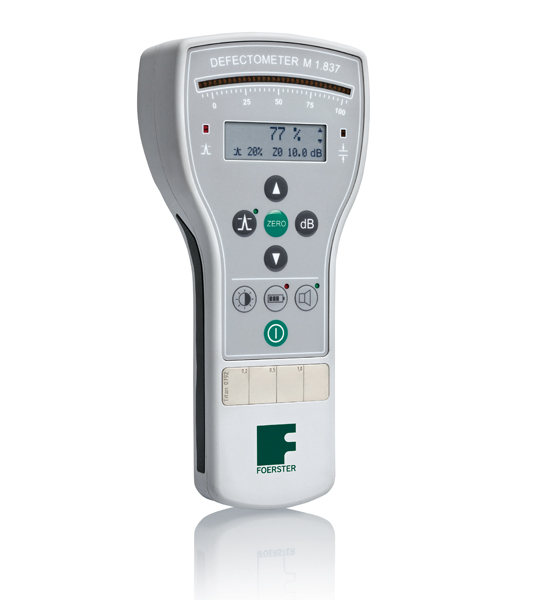
Mobile crack and hardness testing with eddy current for aircraft and automobile components, etc.
The DEFECTOMETER is a modern, highly sensitive eddy current test instrument for manual crack testing. It can also be used for simple hardness testing and material separation. The unit features automatic lift-off, zero, and tilt compensation. The intuitive controls can be operated without prior knowledge.
Typical applications include crack testing on turbine blades, a wheel runs, rivets on aircraft, bridges, rails, and gas pipes, and automotive components as well as simple material differentiation, determining various degrees of surface hardness, and detecting and determining the depth of cracks on semi-finished products.
Technical information
| Sensitivity range: | 0 – 20 dB in increments of 0.5 dB |
| Defect indication: | Red LED display and acoustic warning signal via speaker or headphones |
| Test speed: | 0 – 0.15 m/s |
Portable Eddy Current Flaw Detector for Metal Inspection
The DEFECTOMETER is a portable eddy current flaw detector designed for non-destructive testing of metal components. It helps detect surface and near-surface defects without damaging the material.
Eddy current testing is widely used in manufacturing and maintenance inspection to identify defects such as cracks, seams, and material discontinuities in conductive metals.
The portable design allows engineers to perform fast inspection directly on components, structures, or production parts, making it suitable for both field inspection and production quality control.
Eddy Current Testing for Surface Crack Detection
Eddy current testing uses an electromagnetic field to detect changes in the material structure. When a probe is placed near the surface of a conductive material, the system generates eddy currents inside the metal.
If the material contains a crack or defect, the eddy current flow changes. These changes are detected by the instrument and displayed as a signal, allowing the operator to identify defects quickly.
This testing method allows reliable detection of:
-
surface cracks in metal components
-
material discontinuities and seams
-
corrosion or surface damage
-
defects caused during manufacturing processes
Because the method is non-destructive, inspection can be performed without affecting the component or interrupting production processes.
Typical Applications of Eddy Current Flaw Detection
Portable eddy current flaw detectors are widely used in inspection environments where fast defect detection is required.
Common applications include:
-
surface crack detection in steel bars and components
-
inspection of welds and welded joints
-
detection of defects in aerospace components
-
inspection of railway components and wheels
-
quality control of machined metal parts
These inspections help manufacturers and maintenance teams identify defects early and prevent failures in service.
Industries Using Eddy Current Inspection Equipment
Eddy current testing equipment is used across many industries where metal component reliability is critical.
Typical industries include:
-
aerospace component manufacturing
-
automotive component production
-
railway maintenance and inspection
-
steel and metal processing industries
-
power generation and heavy engineering
In these industries, eddy current inspection supports quality assurance, safety, and compliance with inspection standards.
Advantages of Portable Eddy Current Testing
Portable eddy current flaw detectors provide several advantages for industrial inspection.
Key benefits include:
-
non-destructive inspection of metal components
-
detection of surface and near-surface defects
-
portable equipment suitable for field inspection
-
fast inspection results for production and maintenance
-
reliable crack detection in conductive materials
These advantages make eddy current testing an effective method for industrial inspection and preventive maintenance.
Discuss Your Inspection Application
If your inspection process requires surface crack detection or non-destructive testing of metal components, the DEFECTOMETER provides reliable eddy current inspection for manufacturing and maintenance applications.
Our engineers can help determine the appropriate probe and configuration based on the component geometry, material type, and inspection requirements.
Contact us to discuss your eddy current inspection requirements for metal components.